Rossocinabro x Peace
L’Amore come Linguaggio Universale: "Olive You" di Rebeccah Klodt | Evento inserito nella RAW for PEACE
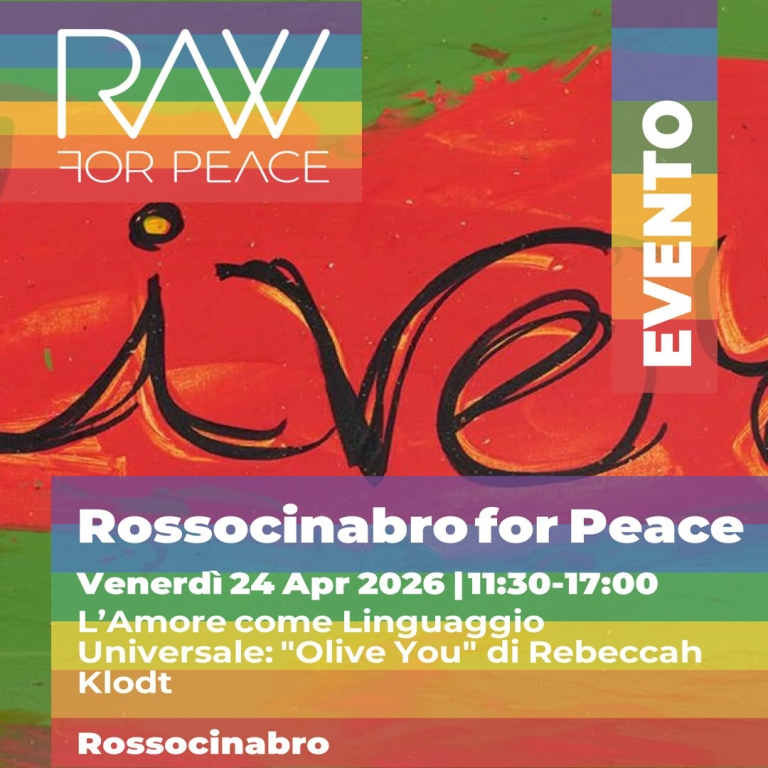
Rossocinabro x Peace
L’Amore come Linguaggio Universale: "Olive You" di Rebeccah Klodt
In occasione della
mostra Rossocinabro for Peace, che si terrà il
prossimo 24 aprile, l’opera dell’artista americana
Rebeccah Klodt emerge come un manifesto visivo
potente e immediato. Attraverso un sapiente gioco di
parole e un uso vibrante del colore, Klodt trasforma
una superficie pittorica in un messaggio di speranza
e riconciliazione.
Un Messaggio per la Pace
La scelta di quest'opera per rappresentare
Rossocinabro for Peace risiede nella sua capacità di
abbattere le barriere. In un periodo storico segnato
da tensioni globali, Klodt ci ricorda che il dialogo
inizia dai gesti più semplici. Quel "xo" (baci e
abbracci) finale trasforma la tela in una cartolina
d’amore inviata al mondo.
L'estetica dell'opera, sospesa tra l'espressionismo
astratto e la pop-art testuale, invita lo spettatore
a non restare un osservatore passivo, ma a diventare
partecipe di questo atto di gentilezza collettiva.
"In un mondo che troppo spesso sceglie il conflitto,
Rebeccah Klodt sceglie la dichiarazione d'amore.
'Olive You' è un invito a guardare al futuro con gli
occhi di chi sa ancora costruire ponti di empatia."
Analisi dell'Opera
L'opera di Rebeccah Klodt si presenta come un campo
di forze cromatiche. Lo sfondo è dominato dal verde
oliva e dal rosso cinabro, colori che non solo danno
il titolo alla galleria e all’evento, ma portano con
sé una profonda simbologia.
Al centro della composizione, la frase calligrafica
"Olive you xo" domina la scena. Si tratta di un
gioco fonetico (un pun) sulla frase inglese "I love
you". Questa scelta non è solo un vezzo stilistico,
ma una strategia comunicativa: Klodt utilizza
l'ironia e la leggerezza per veicolare un concetto
fondamentale. La pace, suggerisce l’artista, nasce
dal riconoscimento dell’altro attraverso l’affetto e
la vicinanza.
“Olive you xo” non è solo un esercizio di word-art,
ma si inserisce in una nobile tradizione pittorica
che vede nel binomio testo-immagine la chiave per
scardinare la percezione dello spettatore.
Il gesto rapido, quasi febbrile, con cui Klodt
traccia "Olive you xo" richiama immediatamente
l'estetica di Cy Twombly. Come in Twombly, la
scrittura perde la sua rigidità tipografica per
farsi "segno vivente". Non è solo una frase da
leggere, ma un tracciato energetico da percorrere
con lo sguardo. La sovrapposizione del nero sul
rosso acceso crea una vibrazione che trasforma la
parola in un graffito urbano, un messaggio d'urgenza
che sembra apparire sui muri della coscienza
collettiva per invocare la pace.
Se Robert Indiana con il suo iconico LOVE ha
trasformato un sentimento in una scultura
architettonica, Klodt sceglie una via più intima e
vernacolare. C'è un'eco della Pop Art di Ed Ruscha
nell'uso del pun (il gioco di parole), dove l'ironia
serve a rendere accessibile un concetto complesso.
Mentre Ruscha spesso isola le parole in spazi
asettici, Klodt le immerge in una "tempesta"
cromatica di rosso e verde, suggerendo che l'amore e
la pace non sono concetti astratti, ma sentimenti
che nascono dal caos e dal fervore della vita reale.
L'uso delle fasce orizzontali di colore evoca le
"Color Field Paintings" di Mark Rothko. Tuttavia, a
differenza della staticità contemplativa di Rothko,
qui la stesura è materica e sporca, piena di
colature e sovrapposizioni.
Il Verde Oliva, che incornicia l'opera, agisce come
un confine protettivo: è il colore della terra,
della mimetica militare che però qui si spoglia
della sua funzione bellica per tornare a essere
colore della natura e della "frasca" d'ulivo
biblica.
Il Rosso Centrale agisce come un cuore pulsante o
una ferita aperta che viene "curata" e sigillata
dalla parola d'amore sovrastante.
C'è una generosità intrinseca nel "xo" finale di
Klodt che ricorda l'accessibilità democratica
dell'arte di Keith Haring. Come Haring utilizzava
simboli universali per parlare di vita, morte e
amore sociale, Klodt usa la calligrafia corsiva per
stabilire una connessione diretta e non elitaria con
il pubblico di Rossocinabro for Peace. L'opera
diventa un "abbraccio visivo", un invito alla tregua
che utilizza il linguaggio quotidiano per parlare di
valori eterni.
In questa tela, Rebeccah Klodt riesce a sintetizzare
la forza dell'espressionismo astratto con
l'immediatezza della comunicazione contemporanea.
L'opera non urla la pace come una protesta rabbiosa,
ma la sussurra come una necessità vitale,
trasformando un semplice gioco di parole in un atto
di resistenza poetica.
Dettagli dell'Evento
• Mostra: Rossocinabro for Peace
• Data: 24 Aprile 2026
• Artista: Rebecca Klodt
• Curatela:Cristina Madini
Rossocinabro for Peace
L’Amore come Linguaggio Universale: "Olive You" di Rebeccah Klodt
Rossocinabro for Peace
Love as a Universal Language: "Olive You" by Rebeccah Klodt
Venerdì 24 Apr 2026 • 11:30-17:00
Rossocinabro • Via Raffaele Cadorna 28 • Roma
Accesso libero
Organizzatore/Organizer
Rossocinabro
Love as a Universal Language: "Olive You" by Rebeccah Klodt
On the occasion of the exhibition Rossocinabro for Peace, to be held
on April 24th, the work of American artist Rebeccah Klodt emerges as
a powerful and immediate visual manifesto. Through a skillful play
on words and a vibrant use of color, Klodt transforms a pictorial
surface into a message of hope and reconciliation.
A Message for Peace
The choice of this work to represent Rossocinabro for Peace lies in
its ability to break down barriers. In a historical period marked by
global tensions, Klodt reminds us that dialogue begins with the
simplest gestures. That final "xo" (hugs and kisses) transforms the
canvas into a love postcard sent to the world.
The aesthetic of the work, suspended between Abstract Expressionism
and textual Pop Art, invites the viewer not to remain a passive
observer, but to become a participant in this act of collective
kindness.
"In a world that too often chooses conflict, Rebeccah Klodt chooses
a declaration of love. 'Olive You' is an invitation to look to the
future through the eyes of those who still know how to build bridges
of empathy."
Analysis of the Work
Rebeccah Klodt’s work presents itself as a field of chromatic forces.
The background is dominated by olive green and cinnabar red—colors
that not only reference the name of the gallery and the event but
carry deep symbolism.
At the center of the composition, the calligraphic phrase "Olive you
xo" dominates the scene. This is a phonetic pun on the English
phrase "I love you." This choice is not merely a stylistic whim but
a communicative strategy: Klodt uses irony and lightness to convey a
fundamental concept. Peace, the artist suggests, is born from the
recognition of the "other" through affection and proximity.
“Olive you xo” is not just an exercise in word-art; it fits into a
noble pictorial tradition that sees the pairing of text and image as
the key to unsettling the viewer's perception.
The rapid, almost feverish gesture with which Klodt traces "Olive
you xo" immediately recalls the aesthetic of Cy Twombly. As in
Twombly’s work, writing loses its typographic rigidity to become a
"living sign." It is not just a phrase to be read, but an energetic
path to be traveled by the eye. The layering of black over bright
red creates a vibration that transforms the word into urban
graffiti—an urgent message appearing on the walls of the collective
conscience to invoke peace.
While Robert Indiana, with his iconic LOVE, transformed a feeling
into architectural sculpture, Klodt chooses a more intimate and
vernacular path. There is an echo of Ed Ruscha’s Pop Art in the use
of the pun, where irony serves to make a complex concept accessible.
However, while Ruscha often isolates words in aseptic spaces, Klodt
immerses them in a chromatic "storm" of red and green, suggesting
that love and peace are not abstract concepts, but feelings born
from the chaos and fervor of real life.
The use of horizontal bands of color evokes Mark Rothko’s "Color
Field Paintings." Yet, unlike Rothko’s contemplative stillness, the
application here is tactile and raw, full of drips and overlaps.
The Olive Green framing the work acts as a protective border: it is
the color of the earth and military camouflage, but here it sheds
its bellicose function to return to being the color of nature and
the biblical olive branch.
The Central Red acts as a beating heart or an open wound that is "healed"
and sealed by the overlying words of love.
There is an intrinsic generosity in Klodt’s final "xo" that recalls
the democratic accessibility of Keith Haring’s art. Just as Haring
used universal symbols to speak of life, death, and social love,
Klodt uses cursive calligraphy to establish a direct, non-elitist
connection with the audience of Rossocinabro for Peace. The work
becomes a "visual embrace," an invitation to a truce that uses
everyday language to speak of eternal values.
In this canvas, Rebeccah Klodt successfully synthesizes the strength
of Abstract Expressionism with the immediacy of contemporary
communication. The work does not scream for peace as a dynamic
protest, but whispers it as a vital necessity, transforming a simple
pun into an act of poetic resistance.